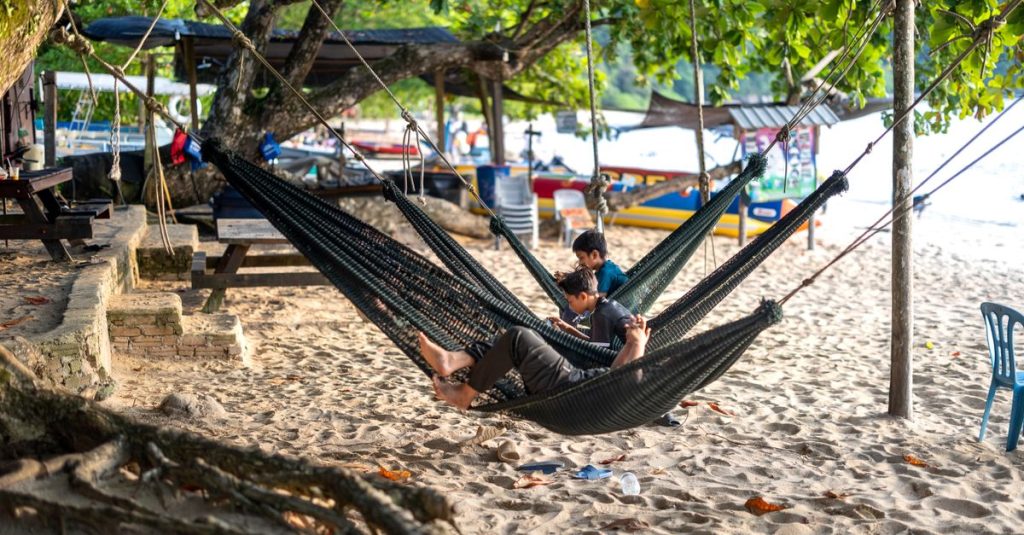
Pangkor Island: Beaches, Access and Things to Do
Discover Pangkor Island, from its beaches and fishing villages to ferry access, activities and practical tips for planning your stay.

Published on
Malaysia’s official language is Malay, known as Bahasa Malaysia or Bahasa Melayu. English is widely used in cities, tourism and business, but proficiency varies depending on the person and location. Mandarin, Tamil and various regional languages also play an important role in everyday life.
For travelling, practical English and a few local expressions provide a good foundation. For settling in, understanding language practices also helps with official procedures, work and relationships with neighbours. This diversity reflects the country’s history: the language used depends as much on the context as on the region or family background.
In brief
Malay is the national and official language at federal level. It enables people from different communities to communicate and plays a central role in administration, national public education and institutional communications. This status does not mean that every household uses it as its mother tongue.
Bahasa Malaysia means “the language of Malaysia”, while Bahasa Melayu means “the Malay language”. In everyday usage, these names largely refer to the same language, with a national nuance in the first case and a linguistic or cultural nuance in the second.
Another distinction is useful in English: “Malaysian” refers to something connected with the country, while “Malay” can refer to the language or the Malay community. Not all Malaysians are Malay, and their language repertoires may therefore be very different.
Everyday writing uses the Latin alphabet, known as Rumi. It is therefore possible to recognise words on signs, menus and documents without learning a new writing system, even though pronunciation takes some practice.
Jawi, adapted from Arabic script, is still used in some religious, cultural and institutional contexts. Malay is not therefore a language derived from Arabic: it belongs to the Austronesian family, despite borrowings linked in particular to the history of Islam.
Its closeness to Indonesian can sometimes make it easier to understand. However, vocabulary, pronunciation and expressions differ: knowing Indonesian is an advantage, not a guarantee that you will understand every local conversation.
When starting out, it is better to learn complete phrases rather than isolated words. Standard Malay provides a common foundation; informal usage and regional accents can then be learned through contact with other speakers.

English generally makes it possible to manage everyday tourist interactions in major cities and establishments accustomed to international visitors. Asking for a room, giving a destination or asking a simple question is often possible without mastering local vocabulary.
In Kuala Lumpur, English is common in hotels, shops and international professional environments. Our guide to Malaysia’s capital, Kuala Lumpur, helps you prepare for this first urban stop.
The situation may change in a small neighbourhood shop, a village or when speaking with someone less accustomed to foreigners. It would therefore be misleading to assume that everyone speaks the language fluently.
Its current position is explained in part by the history of British presence, followed by its continued use in education, business and international exchanges. It can also serve as a common language between people from different linguistic backgrounds.
The local accent and certain turns of phrase may be confusing at first. In informal conversations, you may also hear Manglish, a colloquial form combining English elements with local influences, including the familiar particle “lah”.
Not every exchange takes this form: the register varies depending on the setting and the people involved. There is no need to imitate these expressions to fit in; simple, clearly pronounced wording is more effective.
If you do not understand, rephrase rather than speaking louder. When travelling, showing the written address and the exact name of the establishment reduces ambiguity; the guide to transport in Malaysia provides further preparation.
French is an occasional possibility, not a general solution. If French-speaking assistance is essential, confirm this skill directly with the provider before booking.
Malaysia’s linguistic diversity extends far beyond the Malay–English pairing. Family, school and professional languages do not necessarily coincide. One person may use several languages during the day, depending on their social circle and the needs of the conversation.
Mandarin has an important place within Chinese communities, particularly in certain educational pathways and in the media. Hokkien, Cantonese and Hakka are also still spoken, with usage varying between families and regions.
These varieties are not simply interchangeable accents. Often grouped under the term “Chinese dialects”, they can differ considerably: understanding Mandarin does not automatically enable someone to follow a conversation in Hokkien.
Tamil is an important part of the linguistic heritage of Malaysians of Indian origin. However, it does not represent every family in this community, whose origins and languages are diverse.
| Language or language group | Contexts of use | Practical point |
|---|---|---|
| Mandarin | Family, education, media and commerce | Useful in some interactions, but not shared by everyone |
| Hokkien, Cantonese, Hakka | Family networks, local life and shops | Understanding depends on the variety spoken |
| Tamil | Family, culture, education and religious life | Does not represent all languages of Indian origin |
| Indigenous languages | Community life and cultural transmission | Usage differs considerably between regions |
In Sabah and Sarawak, languages such as Iban and those of Kadazan and Dusun communities contribute to cultural life. On the peninsula, Orang Asli peoples also have their own languages, which should not be treated as varieties of Malay.
Malay itself also has regional varieties, particularly in Kelantan, Terengganu and Kedah. Their pronunciation and vocabulary may surprise learners familiar only with the standard form.
A person’s appearance does not reveal which languages they speak. Simply asking which language they prefer is more relevant than assuming their abilities based on their presumed origin.
A few well-chosen phrases make initial exchanges easier, even when the conversation then continues in English. The aim is not to recite an entire vocabulary, but to be able to greet someone, say thank you and make a clear request.
“Selamat pagi” is a morning greeting, not a form of hello suitable for every time of day. “Apa khabar?” means “How are you?”, while “Terima kasih” can be used to say thank you in many different situations.
When saying goodbye, the distinction depends on who is leaving: “selamat tinggal” is addressed to the person staying, while “selamat jalan” is addressed to the person leaving. These expressions are therefore best learned with their context rather than with a single translation.
Recognising “nasi” for rice, “ayam” for chicken and “ikan” for fish helps when deciphering a menu. These reference points become more useful when combined with the dishes presented in our guide to Malaysian cuisine.
Vocabulary alone is not enough to identify every ingredient. For satay skewers and their accompaniments, as with any dish containing a sauce, ask for clarification if you have a dietary restriction.
An allergy requires explicit confirmation, not just a translated word displayed on a screen. A written note adapted to your needs can help you ask the question, but it does not replace checking with the person preparing the meal.
For a long-term stay, learning Malay provides a degree of independence that English alone cannot guarantee. Understanding a message from neighbours, an administrative instruction or an explanation in a shop makes life easier outside tourist circuits.
The language used professionally depends on the employer, sector and team. An international company may work largely in English, while certain roles dealing with local customers require other language skills.
Before accepting a job or assignment, clarify which languages are used in meetings, documents and dealings with customers. To prepare for remote work, the guide to working remotely in Malaysia places this question alongside the other aspects of settling in.
For official procedures, do not assume that an English-language document will always be available or accepted. Ask the relevant organisation which version must be provided and whether a particular translation is required; for entry and residence, check the current requirements with the competent authorities.
Start with vocabulary you actually encounter: housing, food, transport and healthcare. Reusing one expression in several conversations is more helpful than collecting terms you rarely use.
A translation app can unblock a simple request, but proper names, informal wording and mixed-language sentences may be misinterpreted. For a medical instruction or contractual commitment, have the meaning confirmed by a competent speaker.
Fluency is built mainly by adapting the way you communicate: short sentences, written information and checking important points. Choosing a language understood by both parties matters more than searching for a perfect formulation.
Yes, particularly in major cities and places accustomed to international visitors. Practical English makes travelling easier; a few local expressions and written addresses remain useful elsewhere.
French is uncommon. Some guides or professionals speak it, but you should confirm this possibility directly before booking a French-speaking service.
No. They are closely related and share much of their structure, but differ in vocabulary, pronunciation and usage. Understanding also depends on the register being used.
It is not a general necessity. Its usefulness depends on your social circle and occupation. Malay provides a common foundation for local life, while English is useful in many professional contexts.
Discover Pangkor Island, from its beaches and fishing villages to ferry access, activities and practical tips for planning your stay.

Discover Sepilok in Borneo and observe orangutans in the rainforest, while learning about rehabilitation and wildlife conservation.

Explore the Kinabatangan River in Borneo with boat safaris, proboscis monkeys, orangutans, pygmy elephants and rainforest wildlife.

Discover Malaysia itineraries for 10 days, 2 or 3 weeks, with essential stops and practical advice for organising your trip.

Discover roti canai, Malaysia’s flaky, crisp breakfast flatbread, served with curry or dhal and enjoyed at mamak restaurants or home.

Discover Sipadan, Borneo’s legendary island: diving permits, the best season and practical advice for planning your underwater adventure.
Discover Malaysia’s population, ethnic diversity and main religions, and understand the differences between citizens, residents and communities.

Experience the Malaysia MotoGP Grand Prix at Sepang: practical advice on tickets, access, accommodation and making the most of race day.
Scroll to see more articles →