
Pangkor Island: Beaches, Access and Things to Do
Discover Pangkor Island, from its beaches and fishing villages to ferry access, activities and practical tips for planning your stay.
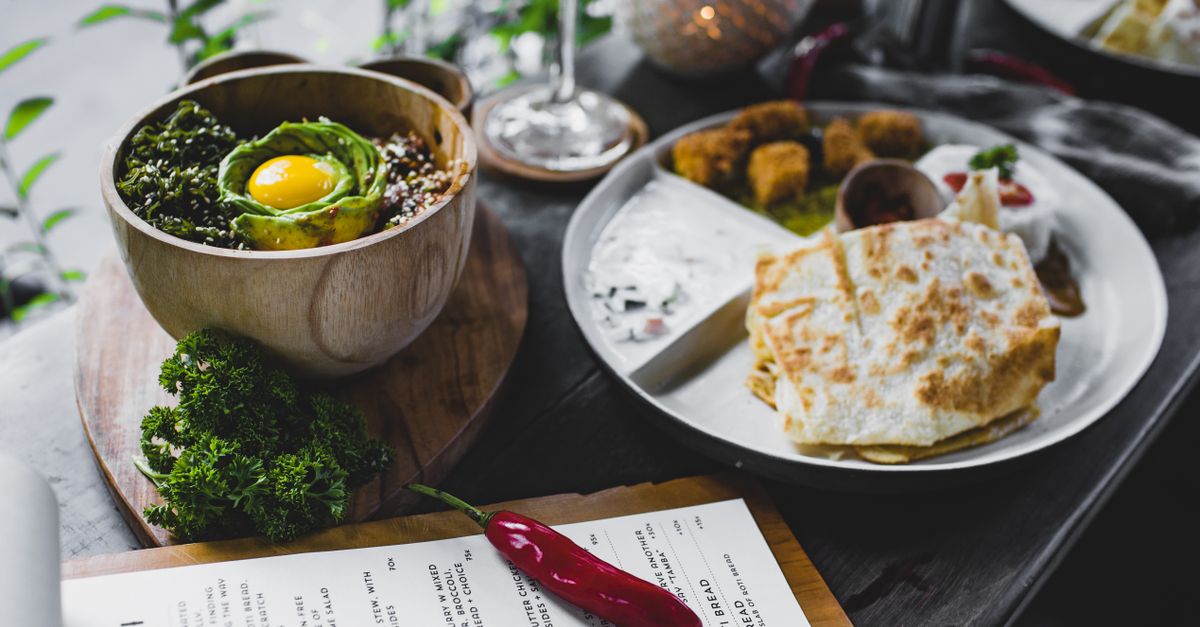
Published on
Roti canai is a flaky flatbread, stretched and then folded with fat before being cooked on a hot plate. In Malaysia, it is often enjoyed for breakfast, served with dhal or a curry sauce. Its success lies in the contrast between a crisp surface and a soft interior, with layers that separate when it is torn apart.
Associated with mamak establishments, which originate from the Indian Muslim tradition, this Malaysian speciality is also eaten outside the morning meal. Whether enjoying it in a restaurant or preparing it at home, the same principle applies: understanding how stretching, resting and folding transform a simple dough into flaky bread.
In brief
Roti canai is an emblematic preparation of Malaysian cuisine, but its roots lie in the traditions of the Indian subcontinent. Its spread in Malaysia is closely associated with Indian Muslim communities, particularly Tamil communities.
Describing it simply as a “Malaysian-origin” bread therefore overlooks part of its history. It is better understood as a culinary heritage that has been adapted and embedded in local habits, to the point of becoming a familiar national speciality.
In the restaurant context, the term mamak refers to establishments connected with this Indian Muslim tradition. Their preparation counters often allow customers to watch the dough being stretched, folded and cooked on a flat griddle.
This visible preparation explains some of its appeal in Malaysian street food. The movements nevertheless have a precise purpose: to thin the dough evenly, distribute the fat and produce a flatbread that can cook without remaining compact in the centre.
Its association with the morning does not make it exclusively a breakfast food. Establishments may also offer it at dinner or as a snack, but their opening hours and the availability of the cooking station vary: check directly with the restaurant.
In Singapore, a very similar preparation is known as roti prata. The names vary more than the principle: a sheet of greased dough, folded and browned on a hot surface.
Chapati does not aim for this flakiness, while some parathas also involve working with layers and fat. To identify roti canai, therefore, look less at whether it is round or square than at its internal structure: it should separate into fine layers rather than resemble the crumb of a leavened loaf.
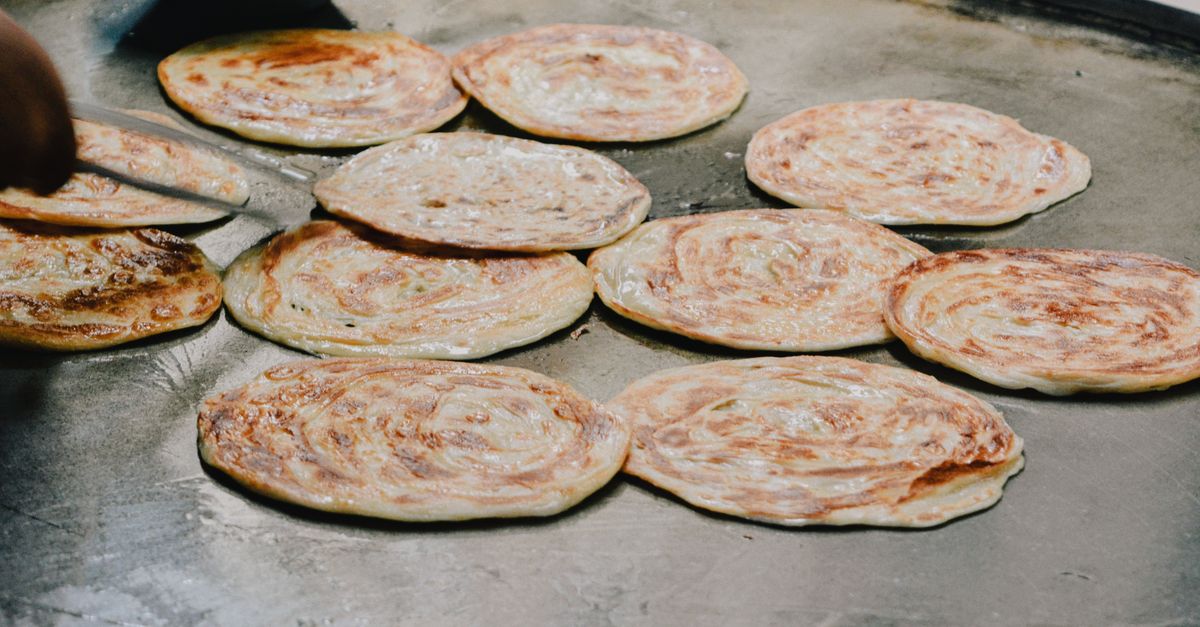
To discover its texture, start with a plain version, often called roti kosong. Without a filling, it is easier to appreciate the differences between a well-browned surface, crisp edges and a soft centre.
A freshly prepared piece offers the best contrast. If it has been sitting in a pile, steam may soften its crust: this is not necessarily a sign of poor preparation, but the result will be less crisp.
The names on the menu help identify the main fillings. Their exact composition remains specific to each establishment, particularly in sweet versions and in the fats used.
| Name | Feature | What to expect on the plate |
|---|---|---|
| Roti kosong | No filling | Flaky texture takes centre stage |
| Roti telur | Egg filling | A softer, more substantial centre |
| Roti pisang | Banana filling | A sweet variation, sometimes served with sugar |
| Roti planta | Use of margarine bearing this name | A preparation enriched with fat |
| Roti bom | Sweet and enriched version | A generally denser texture |
Dhal, a spiced lentil preparation, commonly accompanies this bread. A fish or meat curry sauce may also be offered; its appearance is not enough to identify all its ingredients.
Ask for the accompaniments separately if you want to compare their flavours or control the level of heat. Dip only the piece you are about to eat to keep the rest of the portion crisp.
For religious dietary questions, distinguish the type of establishment from checking its halal status. Our guide to eating halal in Malaysia explains what to check; for up-to-date certification, consult JAKIM’s official information.
A plain version is not a guarantee that it contains no egg or milk: these ingredients may be included in the dough, regardless of the filling ordered.
The distinctive quality of this flaky bread comes from stacking very thin sheets. The fat between them limits adhesion, while the steam produced during cooking helps separate the layers.
This explains why a simply flattened flatbread does not produce the same result. Even with the same ingredients, skipping the stretching and folding creates a more uniform structure without the desired layers.
Kneading develops the gluten network, which gives the dough cohesion. Resting then reduces its resistance to stretching: a ball that retracts strongly is difficult to turn into a thin sheet.
Pulling harder risks tearing it. It is better to cover the portion, protect its surface with a light coating of oil and allow it more time to relax before continuing to shape it.
A dried-out surface creates another problem: it forms a skin that is less extensible than the inside. A covered container and an oily coating therefore also help maintain an even texture while the dough rests.
Even distribution of the fat matters more than adding a large amount concentrated in the centre. Dry areas may stick together, while excess oil cannot correct a thick sheet or folding that is too tight.
The choice also affects the flavour: a neutral oil remains subtle, while ghee adds a buttery note. As ghee comes from milk, it is not suitable for a vegan preparation.
Why can a browned roti still be dense? A thick outer layer or excessive heat may colour the outside before the centre is properly cooked. Thin shaping and control of the heat matter just as much as greasing.
The base combines wheat flour, water, salt and fat; some preparations also include egg. There are variations of the traditional recipe, rather than one formula followed by every cook.
The equipment is basic: a mixing bowl, a sufficiently clear smooth surface, a covered container, a wide heavy-based frying pan and suitable spatulas. A rolling pin can help begin flattening the dough, but working by hand makes it easier to control areas that are still too thick.
Add the water gradually to the salted flour, then work everything until you have a smooth, supple mass. Avoid correcting every sticky sensation with a handful of flour: you may make the dough too firm to stretch.
After resting the oiled, covered portions, flatten one ball on a lightly greased surface. Gently lift the edges and work your way around the sheet, without continually pulling the same spot.
A small tear does not mean you must start again: folding can cover the damaged area. However, repeated tears indicate that the resting time, suppleness or pressure applied needs to be reconsidered.
Spread the fat over the sheet, then fold it into an envelope, or form a strip before rolling it into a spiral. Flatten it gently afterwards to preserve the structure you have created.
Place the flatbread in a preheated, lightly oiled frying pan over medium heat. Turn it to brown it evenly, adjusting the heat if dark marks appear before the inside has cooked.
Once cooked, gently bring the edges towards the centre with the spatulas to help the layers separate. Do not imitate the professionals’ slapping technique with your bare hands: the bread and fat will be extremely hot.
Serve immediately with the sauces already prepared. In this Asian dish, organising the service protects the texture just as much as the cooking technique.
A reasonably fluid curry works well with it: it adheres to the pieces without requiring the whole flatbread to be soaked. Dhal provides a gentler consistency, while a fish or chicken preparation offers a different accompaniment.
At home, a vegetable stew is another option. This is a practical pairing, without presenting every home adaptation as a traditional mamak restaurant service.
For a sweet version, banana and condensed milk have different uses: the banana can be enclosed in the dough, while the condensed milk can be added when serving. An overly generous or wet filling makes sealing more difficult and slows the cooking of the centre.
The preparation contains wheat and therefore gluten. Egg, milk, clarified butter and certain sauce ingredients may also cause problems in the event of an allergy; ask the restaurant about the ingredients and contact with other foods.
Vegetarian and vegan do not mean the same thing. A dough made with ghee or egg may suit some vegetarian diets, but not a vegan diet, which excludes these ingredients as well as sauces containing animal products.
If preparing in advance, keep the dough covered in the refrigerator rather than leaving it for a long time in a hot kitchen. If it is too firm to work with, allow it to soften before shaping, without leaving it at room temperature unnecessarily.
Store cooked flatbreads separately from the sauces and refrigerate leftovers promptly. Storage conditions depend in particular on the fillings; consult ANSES recommendations for general food-safety rules.
To restore a crisp surface, use a frying pan and turn the bread during reheating. A microwave may soften it, but cannot recreate the crust: contact heat is better suited to already-cooked flaky bread.
The beginning of canai is pronounced “ch”, not “k”. In French, “roti tchanaï” provides a useful approximation.
Yes. Some preparations use flour, water, salt and fat. For a vegan version, also check that the dough and sauces contain no milk, ghee or animal ingredients.
No. Gradual stretching on an oiled surface can produce a thin sheet. Resting the dough and using consistent movements matter more than tossing it.
The sheet may be too thick, insufficiently greased or compressed too tightly during shaping. Also check the cooking: a browned surface does not guarantee that the centre is cooked.
Discover Pangkor Island, from its beaches and fishing villages to ferry access, activities and practical tips for planning your stay.

Discover Sepilok in Borneo and observe orangutans in the rainforest, while learning about rehabilitation and wildlife conservation.

Explore the Kinabatangan River in Borneo with boat safaris, proboscis monkeys, orangutans, pygmy elephants and rainforest wildlife.

Discover Malaysia itineraries for 10 days, 2 or 3 weeks, with essential stops and practical advice for organising your trip.

Discover Sipadan, Borneo’s legendary island: diving permits, the best season and practical advice for planning your underwater adventure.

Discover Malaysia’s population, ethnic diversity and main religions, and understand the differences between citizens, residents and communities.

Experience the Malaysia MotoGP Grand Prix at Sepang: practical advice on tickets, access, accommodation and making the most of race day.

Discover Malaysia’s rainy seasons, monsoon patterns on the east and west coasts and in Borneo, and practical tips for planning your trip.
Scroll to see more articles →