
Pulau Ketam: The Fishing Island Near Kuala Lumpur
Discover Pulau Ketam, the fishing island near Kuala Lumpur, with stilt houses, seafood, mangroves and a distinctive coastal village.
Published on
Danum Valley is one of Sabah’s most remarkable places for discovering Borneo’s ancient rainforest. This vast lowland tropical forest is visited in an organised setting, following trails, guided excursions and the humid conditions that shape forest life.
Seeing an orangutan, gibbon or hornbill is possible, but never guaranteed: the animals live in the wild and may remain hidden. The experience is also about giant trees, the canopy, birdsong and tracks revealing abundant biodiversity. To make the most of this immersion, it is best to arrange accommodation, transfers and activities before travelling to Lahad Datu.

In eastern Sabah, Danum Valley protects a vast lowland forest environment. Giant dipterocarps rise above the undergrowth, while several layers of foliage form a dense canopy. The forest is discovered through details: a bird call, a moving branch or insects crossing a shaft of light.
This richness explains the site’s appeal to biodiversity enthusiasts, but it does not turn the visit into a predictable safari. An orangutan or gibbon may be nearby without showing itself. A guide can help you understand the signs, identify sounds and adapt your walk without pursuing the animals. Visitors wishing to learn more about Borneo’s wildlife can also explore this guide to seeing orangutans in Borneo.
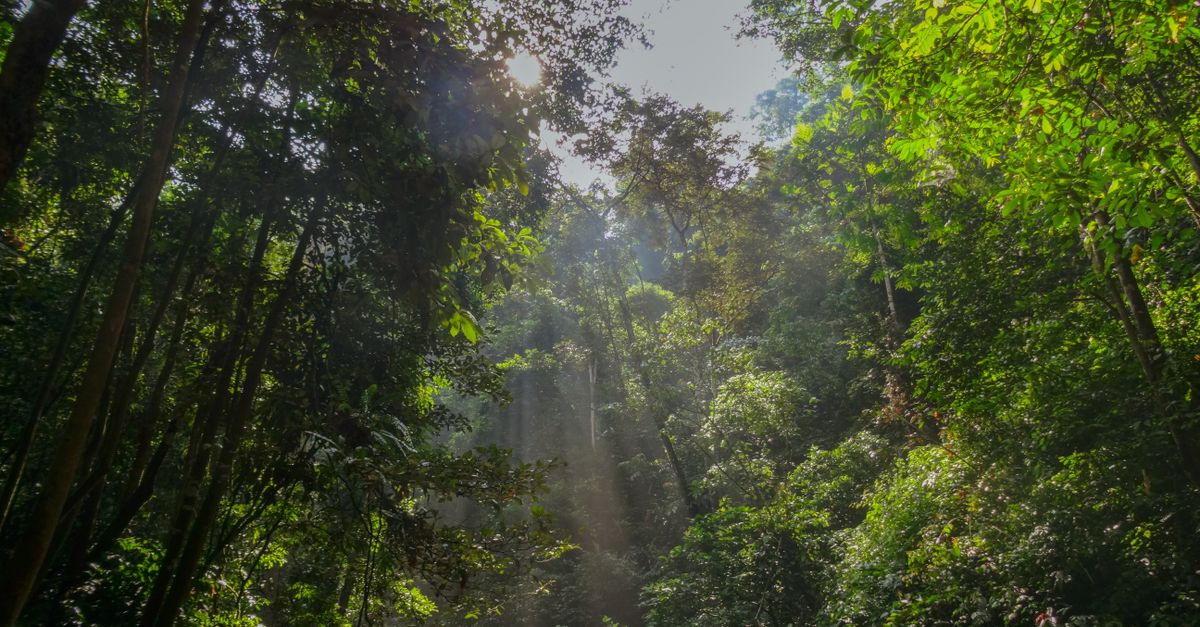
Discretion is essential. Feeding animals, playing sounds to attract them or approaching them disturbs their behaviour and harms conservation efforts. A brief or distant sighting remains a precious experience: the forest is not limited to its most sought-after species.
Travellers wishing to broaden their discovery can consult this guide to Malaysia’s biodiversity and nature parks. It helps place Danum Valley within the country’s range of protected environments, without confusing Borneo’s forests with landscapes in other regions.
Accommodation options include a lodge and a study centre. They do not necessarily offer the same services, routes or facilities. Before booking, clarify what is included: accommodation, meals, guiding, transfers and access to the facilities.
The visit is generally arranged with the people responsible for the stay, particularly because access continues from Lahad Datu by road and tracks. Do not assume that a hire car will allow you to enter freely. Confirm the access arrangements, the type of vehicle permitted and any required authorisations in advance.
| Item to arrange | What to check before departure |
|---|---|
| Accommodation | Which establishment accommodates visitors and which services are included. |
| Transfer | The departure point, vehicle provided and road conditions. |
| Activities | Guided walks and any outings offered in the evening. |
| Prices | The cost of the stay and activities, confirmed with the operator. |
As prices and arrangements may change, request confirmation directly from the organisation managing the visit. To prepare travel around the country, the guide to transport in Malaysia provides useful background; it does not replace the specific access instructions for the valley.
To get online as soon as you land, a Malaysia eSIM can be installed before you leave, with no need to look for a local SIM card.
Activities take place in dense surroundings where the pace of walking matters more than the distance covered. A slow outing makes it possible to notice birds, insects or tracks, even when large mammals remain hidden. Ask the guide about the route’s actual difficulty, its expected duration and whether it can be adapted to your fitness level.
Depending on the establishment and local conditions, the programme may include guided walks or observations after dark. The nocturnal forest reveals different sounds and movements, but an outing does not guarantee a sighting of a big cat or any large animal. Its appeal also lies in listening and learning about behaviour that differs from what is observed during the day.
For photographers, changing light, humidity and fleeting sightings require flexibility. A telephoto lens may be useful, but no equipment can replace patience. Visitors interested in ecotourism should favour an operator that explains the visiting rules and limits disturbance to wildlife. The guide to Borneo’s proboscis monkeys offers another example of wildlife observation where respectful conduct matters.
Conservation also depends on simple actions: stay on authorised routes, follow the guide’s instructions and leave no rubbish behind. In this landscape, the richest experience is not necessarily a spectacular encounter, but a gradual understanding of the links between trees, animals and undergrowth.
Heat and humidity accompany visits throughout the year, with showers that can make trails muddy. A relatively drier period may make some outings easier, without guaranteeing dry weather. Check the forecast before departure and ask the establishment what conditions are expected on the tracks and trails.
Choose lightweight, covering clothing that dries quickly, together with rain protection. Shoes suitable for mud and spare clothes kept dry make days more comfortable. Leeches may be present in wet areas: ask the guide about precautions suited to current conditions.
Before booking, explain your walking ability and any limitations that could affect the choice of route. Do not confuse the lodge’s facilities with those of the study centre: check separately which services your booking provides access to. The guide to Malaysia’s climate can help you prepare your clothing, but local conditions should be confirmed on site.
Do not assume that access is unrestricted. Before travelling to Lahad Datu, confirm the authorisation, suitable vehicle, transfer and entry arrangements with the relevant organisers.
No. These animals live in the wild, and sightings depend on their presence, movements and the conditions at the time. Sounds, tracks and discovering the forest are also part of the visit.
Allowing several nights makes it easier to spread out transfers, daytime walks and any possible night excursions. Confirm the recommended duration according to your accommodation and the activities available.
They depend on the establishment, the organisation of the stay and local conditions. Check availability before booking; they do not guarantee the sighting of any particular animal.
To book tours and activities in Malaysia ahead, see the options on Klook.
Discover Pulau Ketam, the fishing island near Kuala Lumpur, with stilt houses, seafood, mangroves and a distinctive coastal village.
See fireflies along the Selangor River and silvered leaf monkeys at Bukit Melawati in Kuala Selangor, with practical wildlife tips.

Compare the ETS train and bus from Kuala Lumpur to Ipoh, including journey times, transport options and practical tips for choosing.
Discover Fraser’s Hill, a peaceful mountain retreat near Kuala Lumpur, with tropical forest, cool weather, hiking trails and birdwatching.
Discover what to do in Kota Bharu and how to reach the Perhentian Islands, with cultural visits, transport options and practical travel tips.

Discover S-MM2H, Sarawak’s long-stay programme: eligibility, benefits, application steps and checks before living in Malaysia.

Discover Thean Hou Temple in Kuala Lumpur, with practical advice on visiting, access, transport, opening hours and respectful behaviour.

Find out when to visit Kota Kinabalu and Sabah: climate, seasons and practical tips for choosing the best time for your trip.
Scroll to see more articles →