
Pulau Ketam: The Fishing Island Near Kuala Lumpur
Discover Pulau Ketam, the fishing island near Kuala Lumpur, with stilt houses, seafood, mangroves and a distinctive coastal village.
Published on
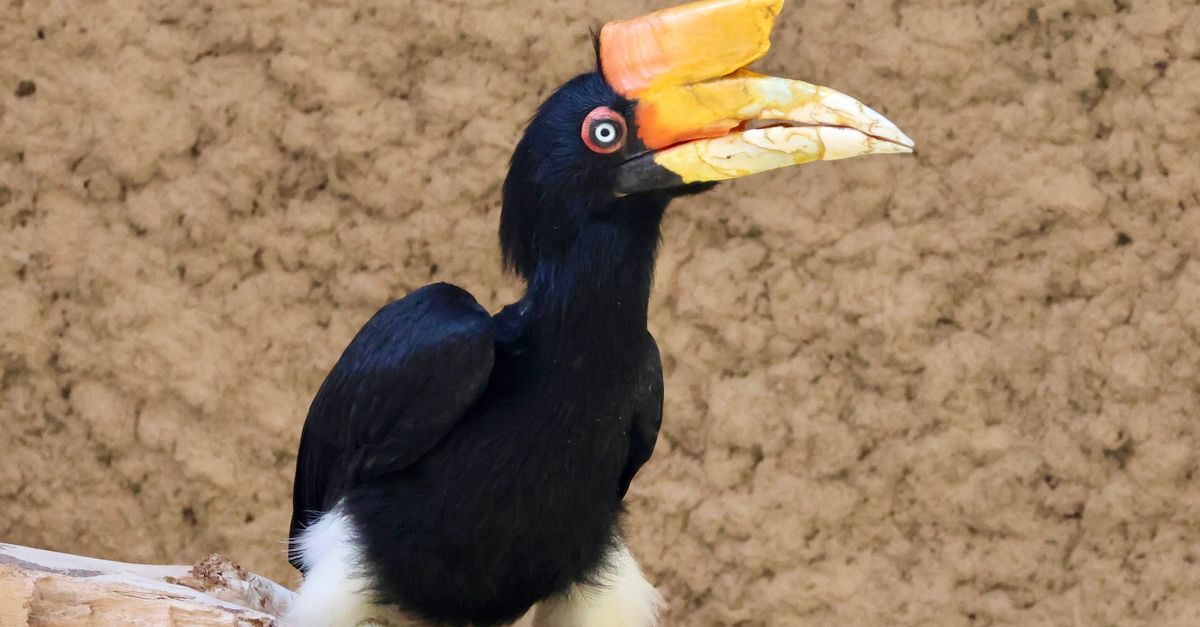
The rhinoceros hornbill is one of Malaysia’s most recognisable birds. Its enormous colourful bill, topped with a raised casque, contrasts with its dark plumage. Particularly associated with Sarawak, whose emblematic bird it is, it also represents the richness of Borneo’s forests. Behind this spectacular appearance is an animal that depends on fruit trees and cavities in old trunks, so its protection concerns an entire ecosystem.
In brief

The rhinoceros hornbill belongs to the Bucerotidae family, which includes hornbills. Its shape combines a robust body, broad wings and a particularly large curved bill. Even when perched high in the canopy, its profile is difficult to confuse with that of a bird of prey or a parrot.
Its plumage is mostly black, while white areas appear on the lower body and tail. The tail has a black band that can help identify the bird when it moves between branches or crosses an opening between trees.
The most distinctive feature is the orange to reddish casque, curved upwards, above the bill. This structure explains the species’ name: it evokes a horn, although it is not a mammal’s horn.
To identify the bird, it is better to consider the ornament’s overall shape rather than its colour alone. Light beneath the foliage, distance and the individual’s age can alter its appearance; a juvenile will not necessarily have an adult’s spectacular silhouette.
| Visible feature | Identification clue | Observation precaution |
|---|---|---|
| Casque | Large, with a raised tip | Observe the profile when the head is unobstructed |
| Bill | Large, curved and brightly coloured | Do not identify the species by colour alone |
| Plumage | Predominantly black with white areas | Allow for canopy shadows |
| Tail | White, crossed by a black band | Use movement to examine the pattern |
Calls are also an indication that hornbills may be present, but experience is needed to identify them correctly. Hearing a powerful call in a tropical forest is not enough to name the species: several birds can produce sounds that carry a long way beneath the vegetation.
Sarawak, the Malaysian state on Borneo, is strongly associated with hornbills in its visual and cultural identity. The rhinoceros hornbill has a special place there, well beyond its interest to birdwatchers.
In some Indigenous traditions, particularly among the Iban, this bird has spiritual and symbolic significance. Hornbill-related representations appear in objects, motifs and artistic expressions whose meaning depends on the community and context.
It is therefore important not to present Borneo’s cultures as a uniform whole. The term “Dayak” covers different populations: their practices, histories and relationships with animals cannot be reduced to a single interpretation.
Similarly, emblematic bird of Malaysia and official national emblem are not interchangeable expressions. The association with Sarawak is specific; the Malaysian dimension described here reflects the bird’s fame and representative value, without automatically giving it official national status.
This distinction helps us appreciate the animal without reducing its presence to a tourist symbol. Its silhouette may appear on a poster or craft object, but its survival depends on much less visible factors: trees that provide food, suitable cavities and landscapes through which it can move.
Recognising the hornbill means looking at its casque, but also understanding the territory with which it is associated.
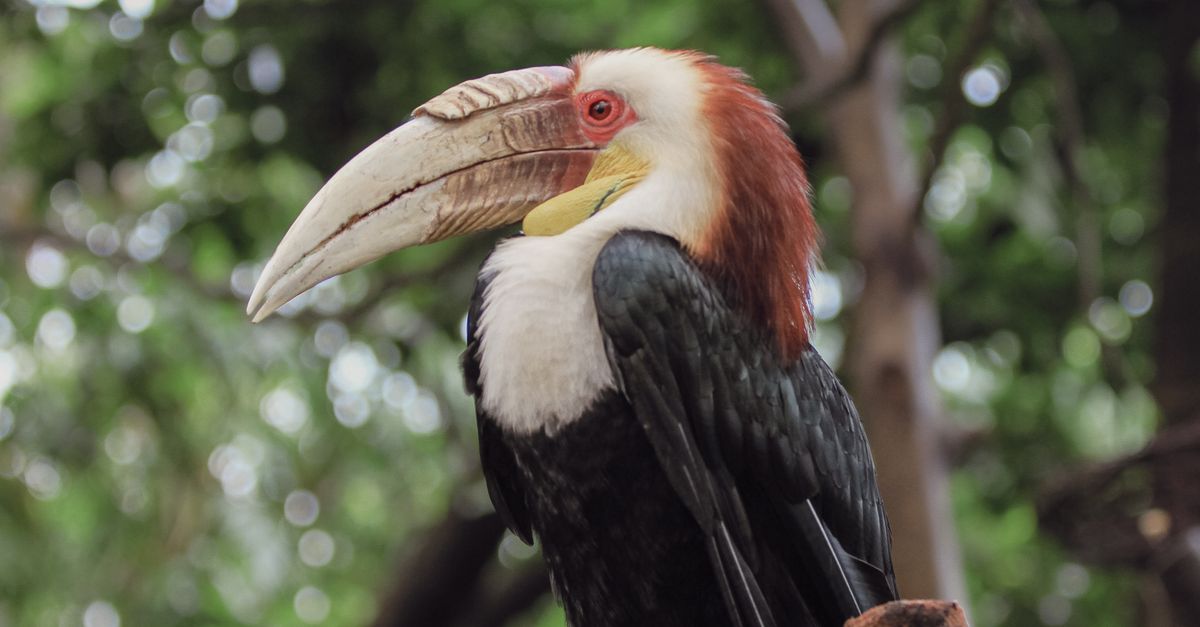
The rhinoceros hornbill lives in the tropical forests of South-East Asia. In Malaysia, it is found both on the peninsula and on Borneo: associating it solely with Sarawak would overlook an important part of its range.
Its environment must provide complementary resources. Fruit trees supply much of its food, while trunks with cavities can offer breeding sites; these functions are not necessarily found in the same place.
In the equatorial forest, food is not available in the same way on every tree or at every moment. A fig tree laden with fruit can become a remarkable centre of activity, then lose its food value once fruiting ends.
The birds’ movements respond partly to this changing distribution of resources. For visitors, this explains why an area visited during one outing may seem empty on the next, without that difference proving a local disappearance.
The structure of the habitat matters as much as its green appearance. A tree plantation, young secondary vegetation and forest containing old trees do not offer the same nesting opportunities, even if they all look densely vegetated in a photograph.
Forest edges and riverbanks can make sightings easier by opening views towards the canopy. They should not, however, be confused with the whole habitat used by the bird: seeing an individual beside a river does not mean that it depends only on the immediately visible corridor.
In Sabah, the Kinabatangan region is known for its diversity of hornbills. The programme presented by Beauval Nature concerns their conservation in this landscape, where riverside woodland is particularly important within a transformed territory.
A trip along the river can provide good conditions for examining the trees from a boat. It does not guarantee a rhinoceros hornbill sighting, however: movements, fruiting, weather and disturbance all influence what can be observed.
On the peninsula, a wildlife-focused outing in Taman Negara places the search for this bird within a broader exploration of the forest environment. The value of an outing then lies not in seeing one species alone, but also in the behaviours and habitats encountered.
Mountain landscapes must also be distinguished from lowland forests. If your itinerary includes Mount Kinabalu and its natural environments, that stop does not automatically replace an outing specifically chosen for hornbill watching.
Before booking, ask which habitat the activity takes place in and whether the operator has recent, correctly identified sightings. An answer describing the terrain and search conditions is more useful than a general promise to see “Borneo’s birds”.
Rain can alter movements, visibility and access to trails. To organise the different stages of your trip, consult our guide to Malaysia’s climate, then check local conditions and any restrictions with the natural area’s manager.
The right choice is not simply a famous destination: it is a suitable habitat visited under good conditions.
The rhinoceros hornbill is mainly frugivorous. Figs are an important part of its diet, but it also eats other fruit and animal prey, including insects and small vertebrates.
Its diet illustrates the close links between animals and tropical trees. A fruit is not merely a temporary resource: eating it can also help move seeds, linking the bird’s feeding habits with the renewal of vegetation.
By swallowing fruit and then moving on, the hornbill can carry seeds away from the plant that produced them. When they are later released intact in a suitable location, they may contribute to forest regeneration.
This does not mean that every seed will grow into a tree. Germination also depends on soil, moisture, light, plant competition and many other factors; the bird is one link in an ecological chain and does not control every stage.
The fig tree is a useful way to understand this relationship. Its fruiting attracts consumers, temporarily brings them together in the canopy and prompts movements that may redistribute seeds across the landscape.
Biodiversity therefore depends on interactions, not just on a list of species. Protecting a large frugivore helps maintain certain exchanges between different parts of the forest, while preserving food trees directly supports its feeding opportunities.
Animal prey supplements this diet. The impressive bill therefore does not indicate an exclusive hunting specialisation: it is also used to grasp and handle fruit, which remains central to the bird’s feeding ecology.
For breeding, the pair uses a cavity in a tree. The female greatly reduces the opening with material including mud and droppings, leaving only a slit through which she can interact with the outside world.
She remains inside during incubation and for a substantial part of raising the young. The male brings food and passes it through the opening, so the success of the brood depends on his ability to continue supplying it.
This arrangement provides protection from certain threats, but also creates strong dependence. If the mate disappears or resources become difficult to find, the occupants cannot simply leave the cavity to look for food themselves.
The nesting site must have suitable dimensions and a suitable configuration. A living or dead tree may look substantial without containing the right cavity; conversely, a hollow trunk considered commercially worthless may be irreplaceable for a breeding pair.
This is why planting young trees does not immediately compensate for the loss of an old tree used for nesting. Developing a favourable forest structure takes time, and the availability of cavities cannot be inferred from the area replanted alone.
This behaviour also requires complete discretion from observers. Staying too close to a nest, obstructing the male’s approach or attracting other visitors can disrupt an essential feeding sequence, even if no bird appears to react dramatically.
To raise its young, the hornbill needs both a refuge tree and a food-rich landscape: protecting one without the other is not enough.
Tip: set up a Malaysia eSIM before departure so your data works on arrival.
A successful sighting begins with distance and patience. In the canopy, the hornbill may remain partly hidden despite its size. Trying to position yourself directly underneath it often creates more movement and noise than waiting from a clear viewpoint.
Binoculars make it possible to examine the casque, tail pattern or handling of a fruit without approaching. For photography, it is better to accept an image showing the bird in its environment than to provoke movement for a tighter shot.
Begin by looking in favourable areas: fruiting trees, dominant branches and openings where flight can be followed. A guide familiar with local species can help distinguish a call, find a silhouette and interpret a movement that might otherwise be mistaken for another animal.
This assistance goes beyond identification. A professional should also know when to stop an approach, recognise a sensitive situation and explain why an observation point is unsuitable, even when the bird appears close.
When an individual carries food and repeatedly returns to the same trunk, a nest may be nearby. The correct response is not to follow its route to the cavity, but to leave its path clear and ask the guide for advice.
From a boat, a calm approach and a stable position reduce disturbance. Navigation decisions should remain with the boat operator: moving closer to a bank solely for a photograph can endanger passengers and disturb other animals.
These precautions have a practical consequence: choose an operator for their methods as much as for their sales pitch. Ask how they respond when a nest is discovered, whether they use bait and whether they are prepared to abandon an approach when necessary.
Equipment preparation also matters during a trip focused on tropical wildlife. Protecting binoculars and cameras from rain, wearing suitable footwear and keeping your hands free helps you observe without compromising your safety.
For access to isolated sites, plan connections with the guide to transport in Malaysia. Departure times, prices and access conditions should be checked directly with the relevant transport operators and site managers, as they may change.
Finally, seeing a captive bird is not a substitute for observing one in the wild and should be described as such. Seeing an animal behind an enclosure can help study certain anatomical details, but says nothing about its natural movements through the landscape.
The best memory is a behaviour observed freely, without your presence having caused it.
Habitat loss and degradation are major threats to the rhinoceros hornbill. Hunting adds direct pressure on individuals, which is particularly concerning for a bird whose reproduction depends on maintaining a pair and suitable nesting sites.
In its 2018 assessment, the International Union for Conservation of Nature classified the species as “Vulnerable”. This category describes an extinction risk assessed globally; for the most recent assessment, consult the IUCN Red List.
The loss of a large tree can have several consequences at once. It may remove a source of fruit, a resting place or a cavity, while also changing the structure of the surrounding canopy.
Careful forest management must therefore consider habitat quality, not just its extent. Maintaining woodland made up of uniform trees guarantees neither varied food supplies nor suitable breeding refuges.
Fragmentation also complicates links between feeding areas and nesting sites. Even if a bird can fly over an open space, it will not necessarily find the resources it needs on the other side.
Wooded corridors and riverside forests can help connect different areas. Their value nevertheless depends on their condition, continuity and surrounding land uses: a strip of vegetation does not automatically become functional habitat merely because it appears on a map.
Artificial nest boxes can complement certain measures where a shortage of cavities has been identified. They require suitable design, monitoring and maintenance, and do not replace food trees or the protection of natural cavities already in use.
The expression protected species refers to legal protection, whereas an IUCN classification is a scientific assessment of risk. One status therefore cannot automatically determine the rules applying to capture, possession or trade.
In Malaysia, protection frameworks and competent authorities differ between the peninsula, Sabah and Sarawak. For any regulatory question, particularly concerning a captive animal, feather or object of animal origin, check the rules in force with the wildlife administration of the relevant territory.
A sale described as traditional or an object offered in a tourist shop does not prove that it is legal. The simplest choice is to favour craft representations made without animal material and ask clearly which materials were used.
A credible programme explains what it aims to improve: protecting nesting trees, monitoring pairs, restoring wooded corridors or reducing collection. It should also distinguish completed actions from results that have actually been observed.
The number of nest boxes installed, for example, is not enough to demonstrate reproductive success. Occupancy, the progress of nesting and the persistence of food resources are more directly linked to the animal’s needs.
Local communities have an essential role through their knowledge of the area and involvement in its management. Responsible wildlife tourism can support guiding jobs and encourage habitat protection, provided it does not increase disturbance around the birds being sought.
Conservation should be judged by the ability to feed, move and reproduce sustainably, not simply by the visibility of an emblem.
It is commonly presented as an emblematic bird of Malaysia and is the emblematic bird of Sarawak. These descriptions should not be confused with an official national designation.
No. The species is also found in Peninsular Malaysia. Sightings depend on the area, food resources and local conditions, and cannot be guaranteed on an excursion.
It mainly eats fruit, particularly figs. It supplements its diet with insects and small animal prey, and helps disperse seeds as it moves through the forest.
The female reduces the entrance to a cavity to protect the nest, leaving an opening through which the male brings food. This makes food delivery and the tranquillity of the site particularly important.
Keep your distance, do not block the adults’ approach and do not share its precise location. Discreetly report the sighting to the guide or natural area manager, without attempting to examine the inside of the cavity.
Discover Pulau Ketam, the fishing island near Kuala Lumpur, with stilt houses, seafood, mangroves and a distinctive coastal village.
See fireflies along the Selangor River and silvered leaf monkeys at Bukit Melawati in Kuala Selangor, with practical wildlife tips.

Compare the ETS train and bus from Kuala Lumpur to Ipoh, including journey times, transport options and practical tips for choosing.
Explore Danum Valley, Borneo’s ancient rainforest, with its remarkable biodiversity, orangutans, guided walks, access details and practical advice.
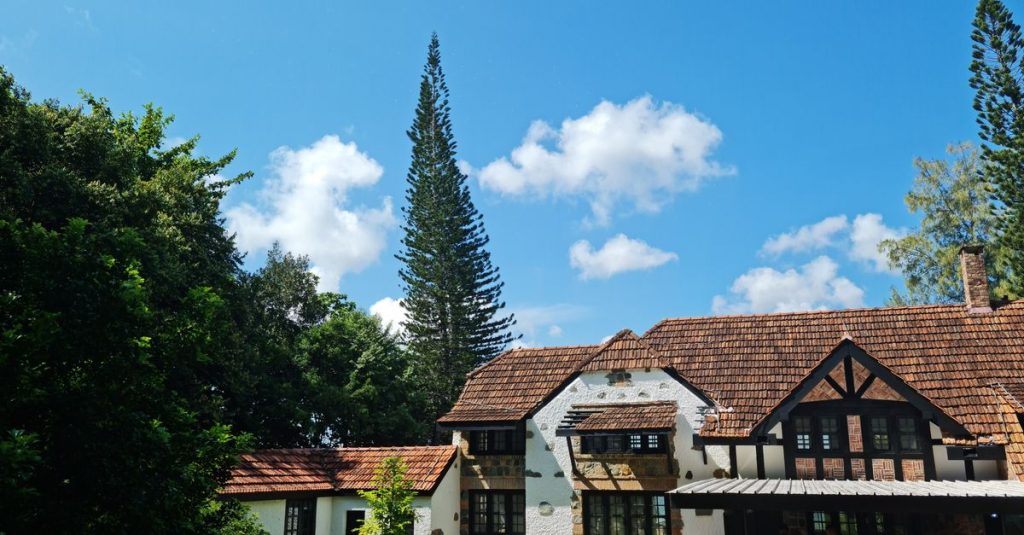
Discover Fraser’s Hill, a peaceful mountain retreat near Kuala Lumpur, with tropical forest, cool weather, hiking trails and birdwatching.

Discover what to do in Kota Bharu and how to reach the Perhentian Islands, with cultural visits, transport options and practical travel tips.

Discover S-MM2H, Sarawak’s long-stay programme: eligibility, benefits, application steps and checks before living in Malaysia.

Discover Thean Hou Temple in Kuala Lumpur, with practical advice on visiting, access, transport, opening hours and respectful behaviour.
Scroll to see more articles →