George Town (Penang): What to See in the UNESCO-Listed City
In George Town, on the island of Penang, a Chinese clan house may be just a few streets away from a mosque, a Hindu temple and former British administrative buildings. This proximity tells the story of a port shaped by migration and trade. The historic centre has been a UNESCO World Heritage Site since 2008, jointly with that of Melaka: its appeal lies as much in the buildings as in the traditions still practised behind their façades.
To discover George Town, Penang, it is best to combine the monuments with everyday experiences: observe the courtyards, look for Ernest Zacharevic’s paintings, have lunch in a popular café, then make your way to the stilt houses along the waterfront. One day is enough to see the main sights; two give you more freedom for interior visits and food stops. Let’s use a first stay for two as our thread, with centrally located accommodation and a desire to understand the city rather than collect photos.

George Town’s UNESCO heritage: monuments to understand and visit
George Town UNESCO: a port city, not a frozen-in-time backdrop
The British colonial establishment of George Town dates back to 1786, when Francis Light took possession of Penang on behalf of the British East India Company. This did not mark the beginning of all human presence on the island: it opened a new period in its history, linked to the development of a strategic trading port.
Trade attracted people from China, the Indian subcontinent and the Malay Archipelago, among other places. Their religious institutions, community associations and trading activities shaped an urban landscape where influences intersect without becoming uniform.
The UNESCO designation concerns a historic area, not the whole island of Penang. The official document on Melaka and George Town explains the value of these trading cities on the Strait of Malacca, as well as their architectural and multicultural heritage.
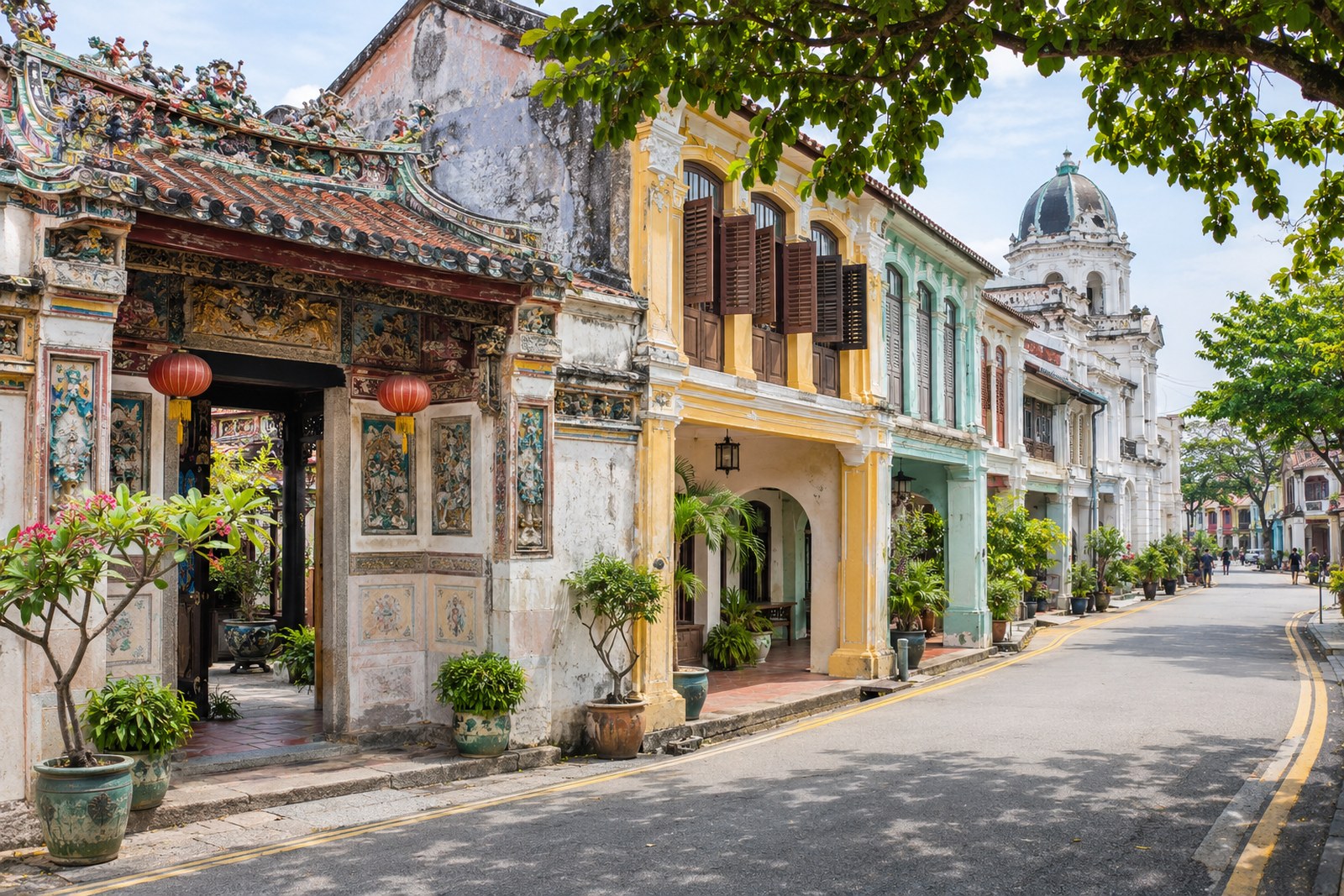
To read this heritage in the streets, look out for shophouses, the shop-houses that traditionally combine business premises and living quarters. Their covered walkways, often called five-foot ways, provide protection from the sun and rain, but their continuity is sometimes interrupted by steps, objects or building work.
Khoo Kongsi: stepping into the history of clan associations
The Khoo Kongsi, accessible from Cannon Square, is one of the most remarkable heritage complexes in the old quarter. It is not simply a “Chinese temple”: it is a clan house associated with a community bearing the Khoo name and its ancestral practices.
Associations of this kind played an important role in mutual support, the integration of new arrivals and the continuity of family ties. This social function gives meaning to the ceremonial halls, inscriptions and richly decorated surroundings, far beyond their photographic appeal.
Once there, take time to look at the sculptures, the roof details and the layout of the courtyard. For our couple of visitors, it is a good first indoor visit: it provides useful keys to understanding the other community houses encountered afterwards.
Access arrangements may change, particularly during private events or ceremonies. Check the official Khoo Kongsi website for the tickets and opening hours applicable during your stay, rather than relying on an old price reproduced online.
Blue Mansion and the colonial quarter: two faces of George Town
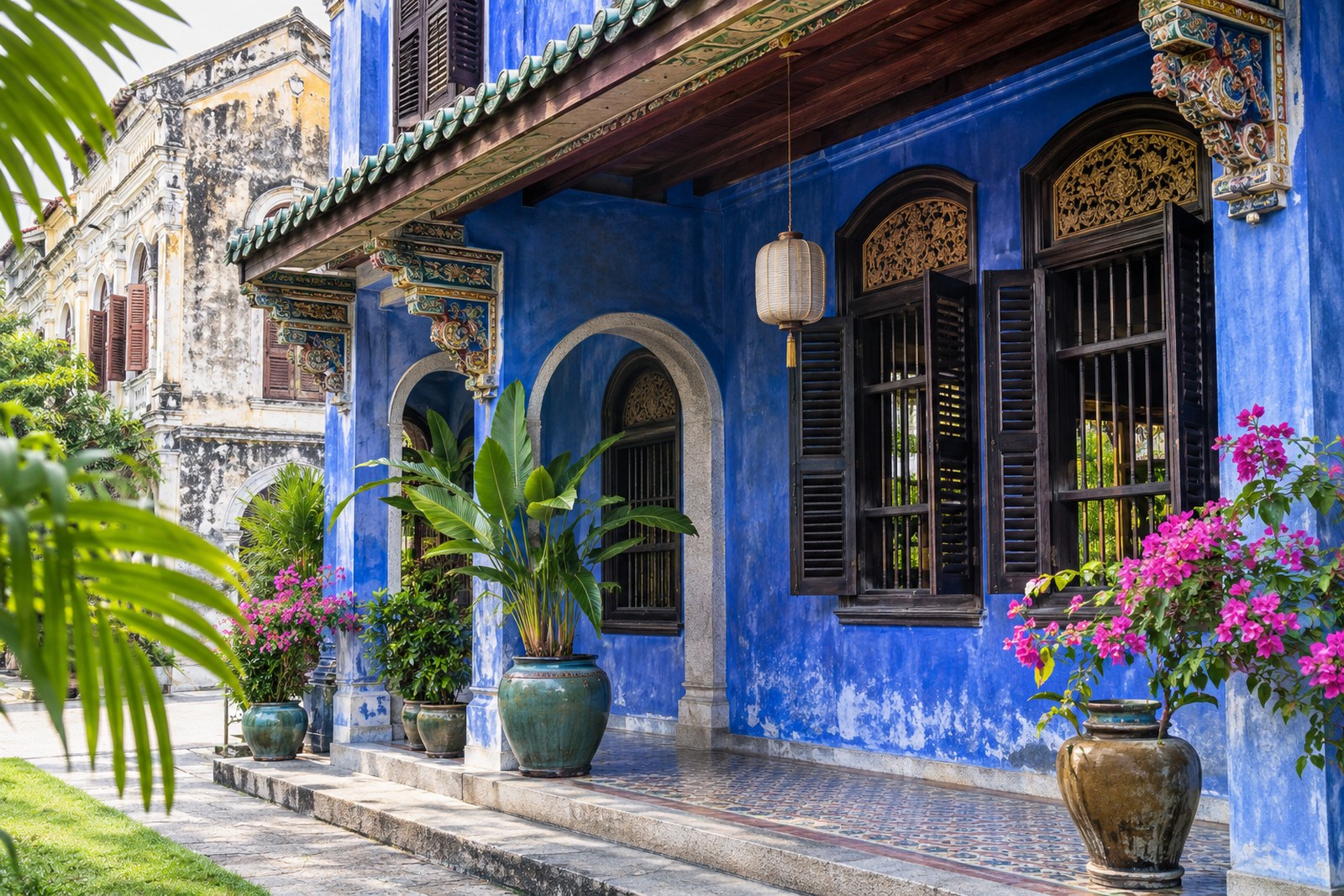
The Cheong Fatt Tze Mansion, known as the Blue Mansion, is named after a merchant and entrepreneur whose life illustrates Asian trading networks. Its indigo colour immediately catches the eye, but its appeal also lies in its courtyards, ventilation and combination of Chinese and European influences.
The building also operates as a hotel, among other things, so a heritage visit does not provide free access to every space. Check the arrangements and available time slots on the official Blue Mansion website, then plan your walk around that booking.
Around the Esplanade, City Hall and Town Hall reveal the administrative dimension of the former colony. Fort Cornwallis adds to this picture, although the areas open to visitors and the interest of the indoor route depend on the works currently under way.
Finally, the area around Jalan Masjid Kapitan Keling allows you to observe several religious traditions within a compact space. Follow the rules specific to each place of worship: covering your clothing, checking whether photography is permitted, and removing your shoes only when requested.
Understanding the function of the buildings transforms the walk: every façade becomes a witness to a community, a trade or a form of power.
Penang street art, Armenian Street and the Clan Jetties: exploring the lived-in city
Ernest Zacharevic: the works that changed George Town’s image
Penang’s street art owes part of its international fame to Ernest Zacharevic, a Lithuanian artist invited to take part in the George Town Festival in 2012. His everyday scenes combine mural painting with real objects, creating a dialogue between the figures depicted and the street.
On Armenian Street, Little Children on a Bicycle has become an emblematic image of the destination. Near Lebuh Ah Quee, Boy on a Bike is also among the works most sought out by visitors.
These creations are not preserved in museum conditions: sunlight, humidity and work carried out on the walls alter their appearance. An old photograph therefore does not necessarily reflect their current state, and a work may have been restored, become less visible or be temporarily inaccessible.
To plan your loop, use the George Town street art trail as a starting point, then adapt once you are there. A map should help you link the streets together, not force you to search for every painting at the expense of everything else.
Also be careful with attributions: not all the murals in the centre are by Zacharevic. The iron silhouettes from the Marking George Town series belong to a different project, which humorously tells stories about local events, trades and the origins of certain street names.
Armenian Street: look beyond the souvenir shops
Armenian Street, or Lebuh Armenian, brings together galleries, shops, cafés and historic buildings. It is a useful landmark, but its commercial bustle represents only one side of the neighbourhood: the adjoining streets often reveal workshops, household shrines or less-restored façades.
Our duo can start with the famous bicycle, then move on as soon as the queue gets longer. Why wait ages for a single picture when a covered passageway, an old sign or an open courtyard can sometimes tell you more about local life?
You could also come back earlier on another morning and leave the pavements clear during photo-taking. Do not climb on the installations or lean against the paintings: their interactive appearance does not mean you are allowed to handle them.
To compare several walking ideas, the guide combining history and urban art in George Town can complement your preparations. However, use the monuments’ official websites as your reference for access conditions.
Clan Jetties: visiting stilted neighbourhoods respectfully
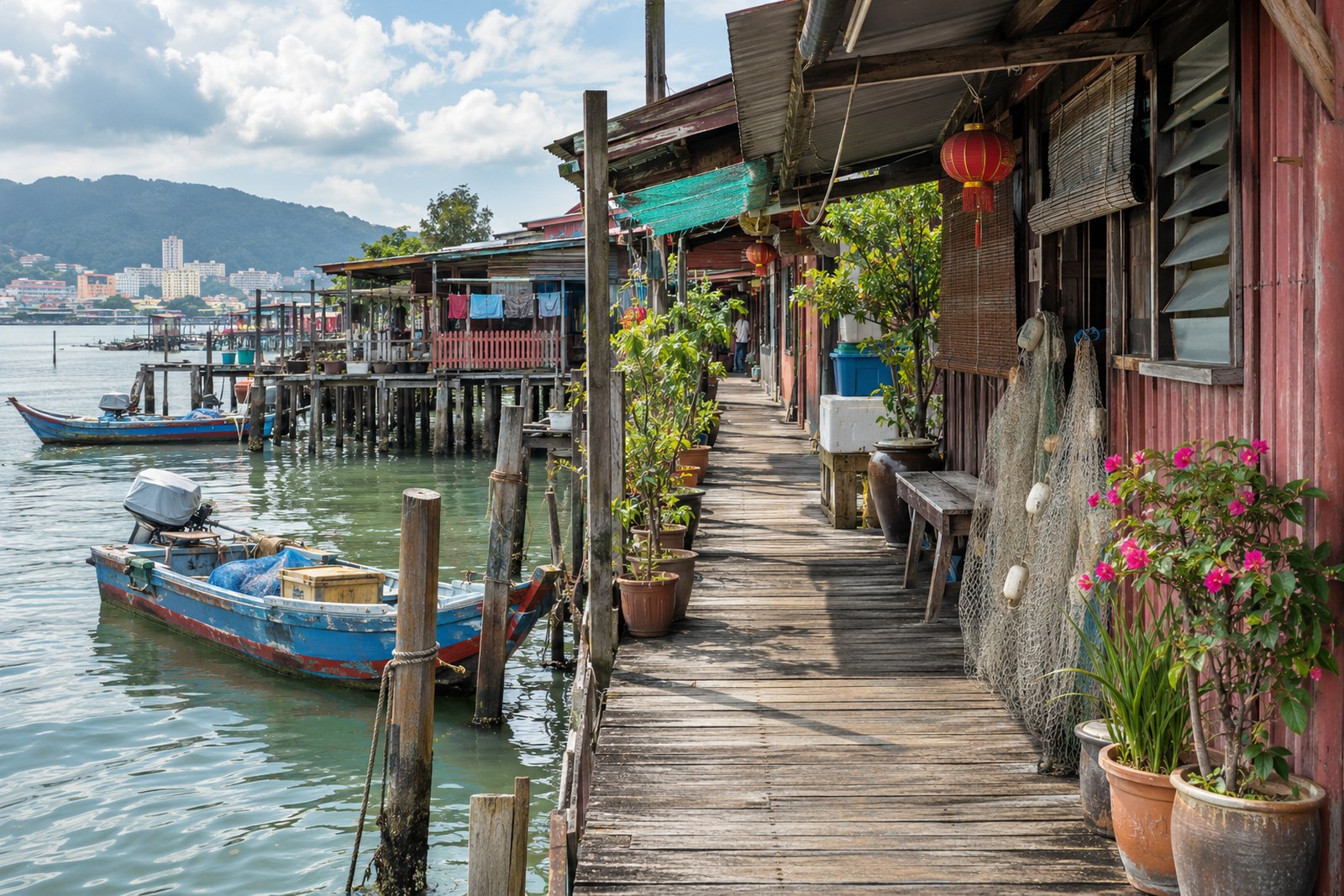
As you head towards the coast, the Clan Jetties show another form of community organisation. These groups of stilt houses developed around maritime activities and family groups; several are still residential areas, rather than simply purpose-built attractions.
Chew Jetty is the best known among visitors, with a main walkway lined with houses and shops. The other jetties should not be treated as freely accessible alternatives: follow the signs and respect local restrictions.
Photograph the views over the water without framing the inside of homes, asking residents to pose or blocking their doors. Keep noise levels down and avoid taking detours through passages marked as private.
The planks may be uneven or slippery after a shower, and the side protection varies from one place to another. With children, a pushchair or mobility difficulties, assess the route before setting off and remain alert to residents moving around.
The best way to encounter these neighbourhoods is to observe without interrupting: their heritage value lies precisely in the fact that they are still inhabited.
Street food in George Town: what to eat and how to choose your hawkers
Penang specialities to try during your stay
The city’s gastronomic reputation is explained by the meeting of Chinese, Malay, Indian and Peranakan traditions. Recipes circulate between neighbourhoods and families, but each preparation retains its variations: two bowls with the same name can offer very different balances of flavour.
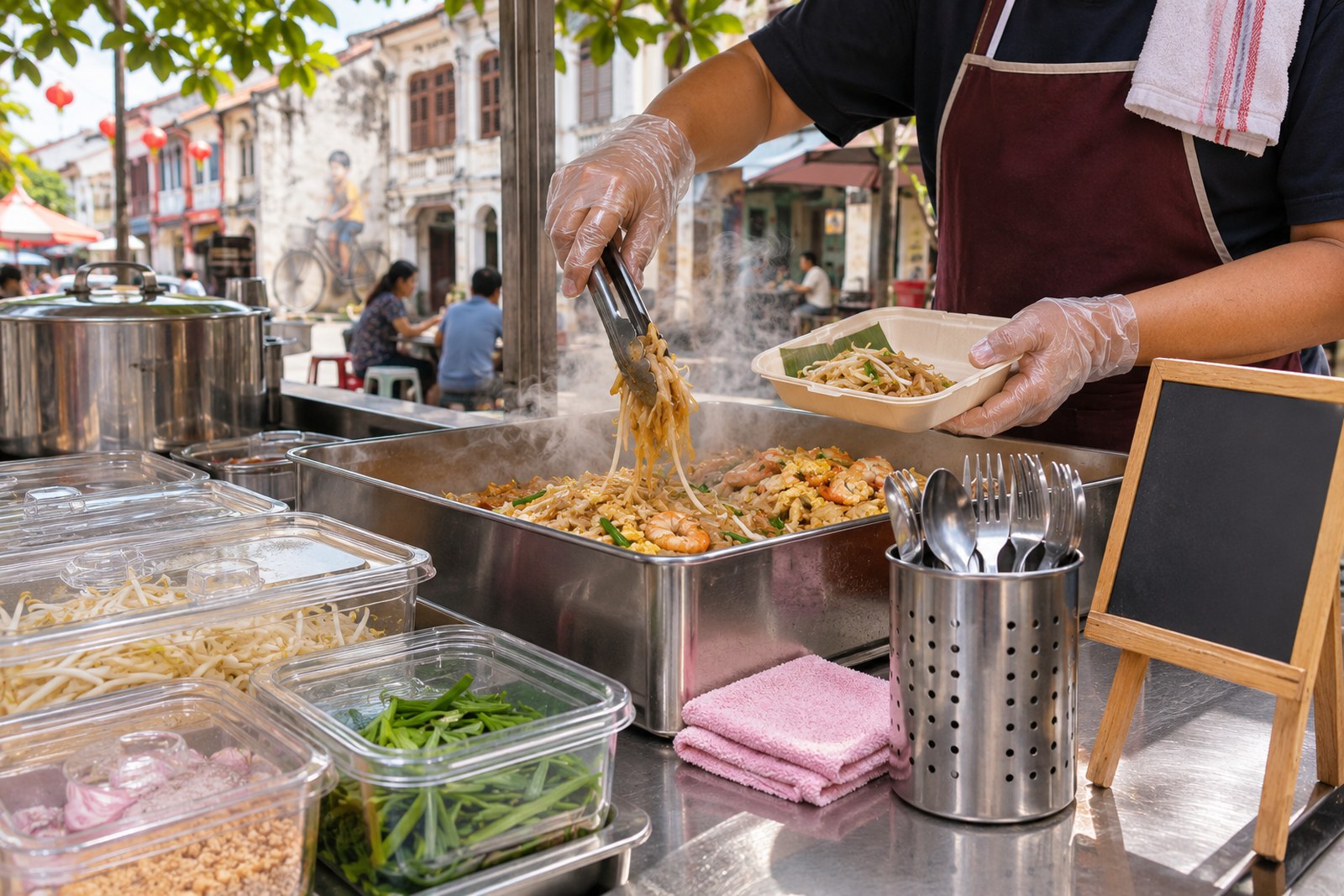
Hawkers are specialist vendors, based on the street, in a market, a popular café or a communal food court. Rather than looking for an establishment offering everything, seek out stalls that focus on one recipe and prepare it regularly in front of their customers.
- Char kway teow: flat rice noodles stir-fried in a wok, usually served with egg, bean sprouts and varying toppings. Some versions contain prawns, shellfish, Chinese sausage or pork fat.
- Assam laksa: a fish and tamarind noodle soup with a tangy flavour, often enhanced with herbs and shrimp paste. It is distinctly different from coconut milk-based laksas.
- Nasi kandar: rice served with various toppings and curry sauces, associated with the Indian Muslim tradition. Your choice of fish, meat and accompaniments affects the bill.
- Penang Hokkien mee: noodle soup in a prawn broth, also frequently prepared with pork. Do not confuse it with the stir-fried thick noodles known by this name in Kuala Lumpur.
- Cendol: a dessert made with shaved ice, coconut milk, palm sugar and green jelly noodles. The toppings vary from one vendor to another.
- Apam balik: a pancake usually filled with peanuts and sugar, and sometimes sweetcorn. Its thickness and crispness vary depending on how it is prepared.
Chowrasta, Kimberley Street and Little India: where to look for food
The area around the Chowrasta market is well suited to morning exploration, with its food shops and surrounding cafés. Here, you can observe a kind of everyday activity different from that of the streets mainly visited for their murals.
Kimberley Street is known for its evening dining options, while Little India offers the chance to explore breads, curries, sweets and drinks. Not all stalls open every day: do not build your plans around a single address without checking its opening arrangements.
A kopitiam, or traditional coffee shop, may accommodate several independent vendors. Depending on how it is organised, you order your food from each stall and your drinks from the coffee shop; observe local practices or simply ask how it works before sitting down.
For our couple on their first visit, sharing several small orders is more interesting than having a very substantial meal in one place. A savoury dish in the morning, a speciality at lunchtime and then a dessert later allow you to compare the flavours without turning the day into an eating marathon.
Hygiene, allergies and prices: good habits at the stalls
Prioritise well-cooked food served hot, and vendors whose handling of the food you can observe. A busy stall is an indication that products are turning over, but this alone does not guarantee hygiene.
Clearly mention any allergies: dried prawns, fish paste, peanuts or sauces may be present without being visible. Ordering “no meat” does not rule out an animal-based broth, and the absence of pork does not constitute halal certification.
Ask the price before adding seafood or several toppings to a mixed plate. Keep cash in small denominations, as digital payment methods available to locals are not always as easy for foreign travellers to use.
Finally, the heat can sometimes reduce your appetite: carry drinking water and allow time for a proper break in the shade. Eating well in Penang means following the specialities and the vendors’ rhythms, rather than looking for a universally “best” address.
What to see in George Town in one or two days: walking itineraries
One day in George Town: link the must-sees without rushing
To know what to see in George Town when time is limited, group the stops by area. The centre looks compact on a map, but the heat, road crossings and photo stops noticeably slow your progress.
Start in the Armenian Street area, before the crowds make the passageways less pleasant. Explore the nearby streets and the closest artworks, then visit Khoo Kongsi if its opening arrangements fit your schedule.
Then make your way to the Clan Jetties, keeping this section reasonably short if the sun is already strong. The waterfront offers less shade than some covered walkways, so a break in an air-conditioned establishment is more useful than taking another detour.
After lunch, cross Little India and the area around the places of worship on Jalan Masjid Kapitan Keling. Set aside the afternoon for the Blue Mansion if you have a time slot, or choose the Esplanade and the colonial façades if you would rather keep your plans flexible.
Finish with dinner in a hawker area. On a single day, choose one major indoor visit rather than accumulating paid admissions: you will keep time for the streets, which are an essential part of the experience.
| Itinerary stage | First day | Optional second day |
|---|---|---|
| Morning, before the strongest heat | Armenian Street, murals and Khoo Kongsi | Chowrasta, traditional cafés and shopping streets |
| Late morning | Chew Jetty and the waterfront | Blue Mansion, subject to booking |
| Afternoon | Little India and religious heritage | Esplanade, City Hall, Town Hall and Fort Cornwallis, subject to access |
| Evening | Sampling food from the hawkers | A second culinary exploration or a walk through the lively streets |
Two days in George Town: adding context and breaks
With a second day, move the Blue Mansion and the colonial quarter out of the first itinerary. You will then be able to visit the monuments without constantly checking your watch, and return to a street whose atmosphere you enjoyed.
The following morning, start around Chowrasta to observe everyday shopping and have a local breakfast. Continue to the indigo mansion, then head to the Esplanade when the weather conditions are suitable.
You can replace one stop with the Pinang Peranakan Mansion, which is particularly interesting for discovering interiors and objects associated with Peranakan culture. This is preferable to accumulating museums covering similar themes during the same half-day.
Our couple then has two evenings to compare the cuisines, rather than trying to taste every speciality during a single meal. This flexibility also makes it possible to postpone a walk after a shower or return to a less crowded mural.
For another perspective on the destination, the Globe Blogueurs’ account of discovering Georgetown may inspire your walks. Always distinguish travel impressions, which are useful for choosing an atmosphere, from practical information that may change.
Adapting your walks to the weather and your mobility
Pavements are sometimes narrow, uneven or interrupted; covered walkways do not form a fully accessible route. With a pushchair, wheelchair or significant fatigue, shorten the loops and plan to use a vehicle between areas.
Take water, sun protection and a compact umbrella, which is also useful against the sun. In a thunderstorm, shelter in a building rather than continuing towards a jetty or open space.
Penang Hill, Kek Lok Si and the beaches of Batu Ferringhi are not part of this walk through the heritage core. Two days focused on the old town offer more depth than a programme scattered across the whole island.
To get online as soon as you land, a Malaysia eSIM can be installed before you leave, with no need to look for a local SIM card.
Visiting George Town: transport, where to stay and practical questions
Getting to George Town and getting around by CAT bus or Grab
From Penang International Airport, Rapid Penang buses are a budget-friendly option, while Grab provides a direct journey to your accommodation. The duration depends heavily on traffic and your address: allow some extra time rather than relying on a fixed journey time from an old guide.
For routes, fares and any changes, consult the official Rapid Penang information. The CAT, a free service operating around the centre, can avoid part of the walk, but its route, stops and operation should be checked before use.
With Grab, choose a pick-up point where the driver can actually stop. One-way streets and congested areas sometimes make it preferable to meet at a nearby junction, in front of an easily identifiable establishment.
If you arrive by train on the mainland, Butterworth is the connection point to the island, notably by ferry. Check crossings with Penang Port and trains with KTMB, taking into account the time needed between the terminals.
A hire car is generally not essential for exploring the old centre. For a trishaw ride, agree the route, duration and total price in advance: the phrase “a few ringgits” does not provide a reliable indication of the actual cost.
Where to stay in George Town according to the way you travel
Armenian Street, Cannon Street and their surroundings suit travellers who want to step straight out into the middle of the main sights. In an old house, however, check the soundproofing, whether there are stairs and whether there is an outside-facing window: architectural charm does not guarantee the comfort you are looking for.
Love Lane and the Chulia Street area make it easy to go out and meet people, but some addresses are affected by bar noise. If you go to bed early, ask for a room away from the street and check recent reviews specifically mentioning nighttime disturbance.
The area around Komtar is convenient for transport and access to shops, with a more urban atmosphere. Gurney Drive may suit a stay prioritising contemporary facilities, but it involves more travel to the historic heart.
For several weeks, test the area before committing: noise, internet connection, workspace and access to meals matter more than a pretty photograph. The guide to working remotely in Malaysia helps identify the points to check beyond simply choosing a hotel.
When should you visit George Town, and which bookings should you make in advance?
The destination can be visited year-round in a hot and humid climate. The beginning of the year is generally less rainy than some periods in autumn, without ruling out showers: check MetMalaysia forecasts as your departure approaches.
Chinese New Year and cultural events can affect visitor numbers, shop opening hours and room availability. Check the George Town Festival calendar for your year of travel, without assuming its dates remain the same from one edition to the next.
Book your accommodation and any visits requiring a time slot first, then keep walks and meals flexible. A good location and a spacious itinerary matter more than a schedule packed from morning to evening.
Frequently asked questions about George Town, Penang
Why is George Town so famous?
George Town is known for its UNESCO-listed multicultural port heritage, shophouses, clan associations, Ernest Zacharevic’s paintings and street food. Its uniqueness lies in the coexistence of these elements in a centre that is still inhabited and active.
What is the difference between Penang and George Town?
Penang refers to a Malaysian state comprising Penang Island and a mainland territory, Seberang Perai. George Town is the capital of this state, located on the island. In tourist guides, its name often refers to the historic centre, which represents only part of the urban area.
Is George Town, Malaysia, worth visiting?
Yes, especially if you enjoy history, architecture, photography and regional cuisines. The destination is best discovered in its streets and everyday places, not only through its monuments. For an exclusively beach-based stay, choose coastal accommodation instead and plan a separate cultural visit.
How many days should you spend in George Town, Penang?
A full day gives you an overview of the must-see sights. Two days allow you to visit several interiors, discover the neighbourhoods at different times and enjoy meals without rushing. Add more time if you want to explore Penang Hill, Kek Lok Si, the beaches or other parts of the island.
Can you visit George Town for free?
Walking through the historic streets and viewing many of the murals is free. Some monuments, museums and guided tours charge an entrance fee. CAT is a free bus service in the centre; check how it operates with Rapid Penang and access conditions directly with the sites concerned.
Book your tickets & activities in George Town
Guided tours, themed excursions and cultural experiences in George Town on Klook, Asia’s No. 1 activities platform. Enjoy flexible cancellations, verified reviews and secure payments as you explore the UNESCO-listed old town with peace of mind.
Affiliate link — booking through this link supports us, at no extra cost to you.
Frequently asked questions
Can George Town be visited for free?
Yes, George Town’s old town can be visited for free. Only some attractions, such as museums and guided tours, may charge a fee. Most temples and street art works are freely accessible.
How long does it take to visit George Town?
To see the main sights, allow at least one full day. If you want to explore more thoroughly, two days allow you to fully enjoy the atmosphere, museums and less touristy neighbourhoods.
Can you visit George Town with children?
Absolutely! Children love the interactive street art and trishaw rides. The temples and markets also offer a fun introduction to the local culture. Plan breaks to avoid tiredness.
What culinary specialities should you try in George Town?
George Town is renowned for its street food. Don’t miss char kway teow (stir-fried noodles), assam laksa (sour fish soup), nasi kandar (rice with curry) and apom balik (filled pancakes). The stalls on Lebuh Kimberley and at Chowrasta Market are perfect for sampling them.
Where can you book a guided tour of George Town?
You can book a guided tour on platforms such as Klook, which offers flexible options with free cancellation and verified reviews. Themed tours (street art, street food and history) are particularly recommended.