Batu Caves: Visit, Prices, Access and Tips (Kuala Lumpur)
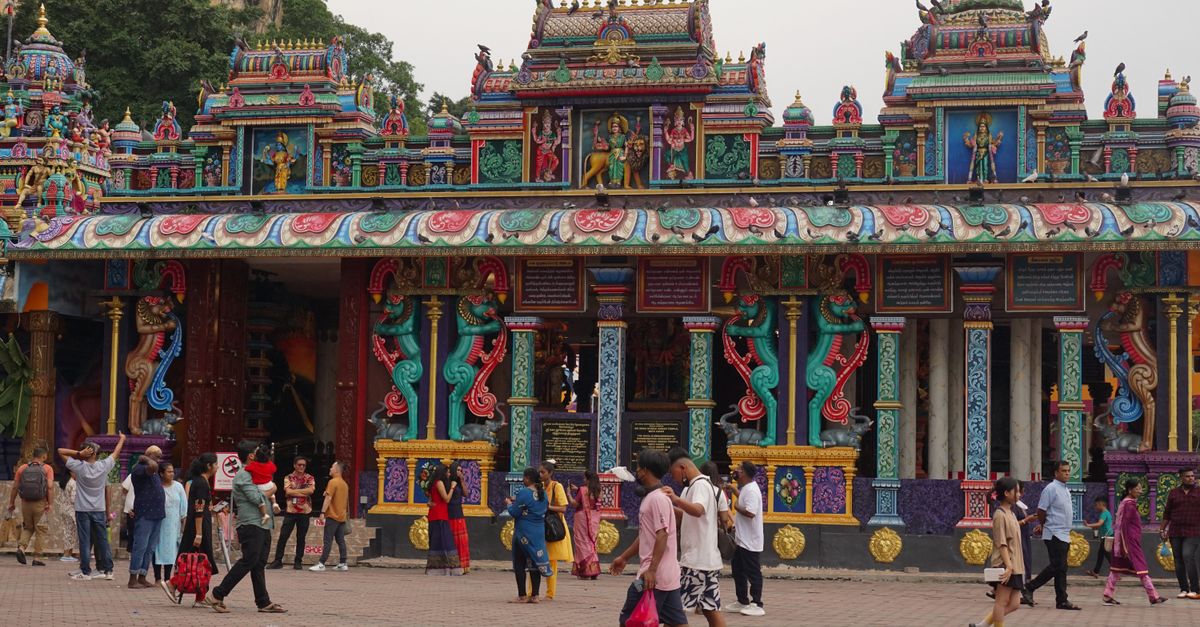
Just outside Kuala Lumpur, the Batu Caves comprise a living Hindu shrine, an immense golden statue of Murugan and caves carved into the limestone hills of Selangor. Beyond the famous image of the 272 colourful steps, the visit takes place in a house of worship: ceremonies, offerings and the movements of worshippers matter just as much as the scenery.
The main point to bear in mind when planning your outing is simple: access to Temple Cave is free, while some additional areas may charge an entrance fee. The KTM Komuter train can take you to the site from KL Sentral, but service times deserve more attention than suggested by itineraries promising an invariably quick journey.
When planning your route, distinguish the main shrine from the other caves, wear suitable clothing and allow some flexibility for the return journey. A standard visit and a visit during Thaipusam require different levels of planning, especially with children or someone who finds stairs difficult.

What to see at Batu Caves: Murugan, the 272 steps and the caves
The statue of Murugan and the Hindu shrine at Batu Caves
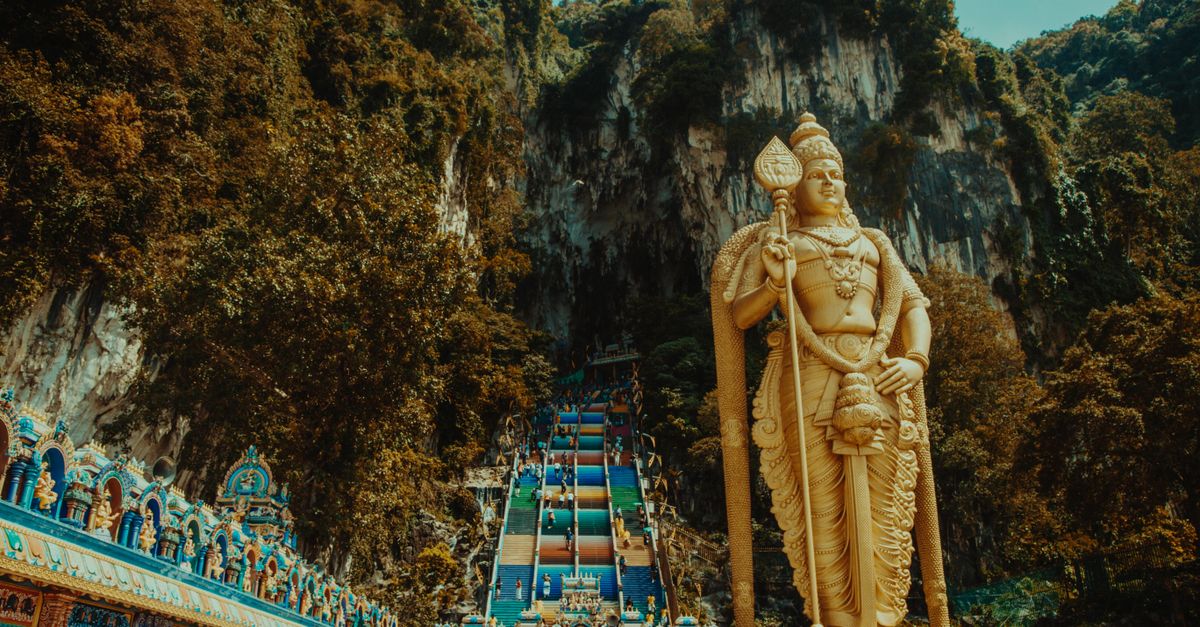
The large golden statue of Murugan stands at the foot of the staircase, not inside the upper cavern. Standing 42.7 metres tall and unveiled in 2006, it represents a particularly important deity in Tamil Hinduism, generally associated with war, victory and wisdom.
The spear carried by Murugan, known as the vel, occupies a central place in his iconography. Observing this attribute before climbing helps you better understand the representations and devotional practices you will encounter later in the complex.
The development of the modern shrine is associated with the Tamil merchant K. Thamboosamy Pillai, who established a place of worship dedicated to Murugan there in 1891. Presenting these caverns as having simply been “discovered” by a Western naturalist in the 19th century would erase the fact that local populations already knew about them.
To place this visit within the country’s cultural landscape, our guide to the religions practised in Malaysia helps explain the coexistence of Hindu, Muslim, Buddhist and Christian traditions. Here, this national diversity takes a very concrete form: you are entering an active religious space, not a setting designed solely for tourists.
The 272 steps and Temple Cave
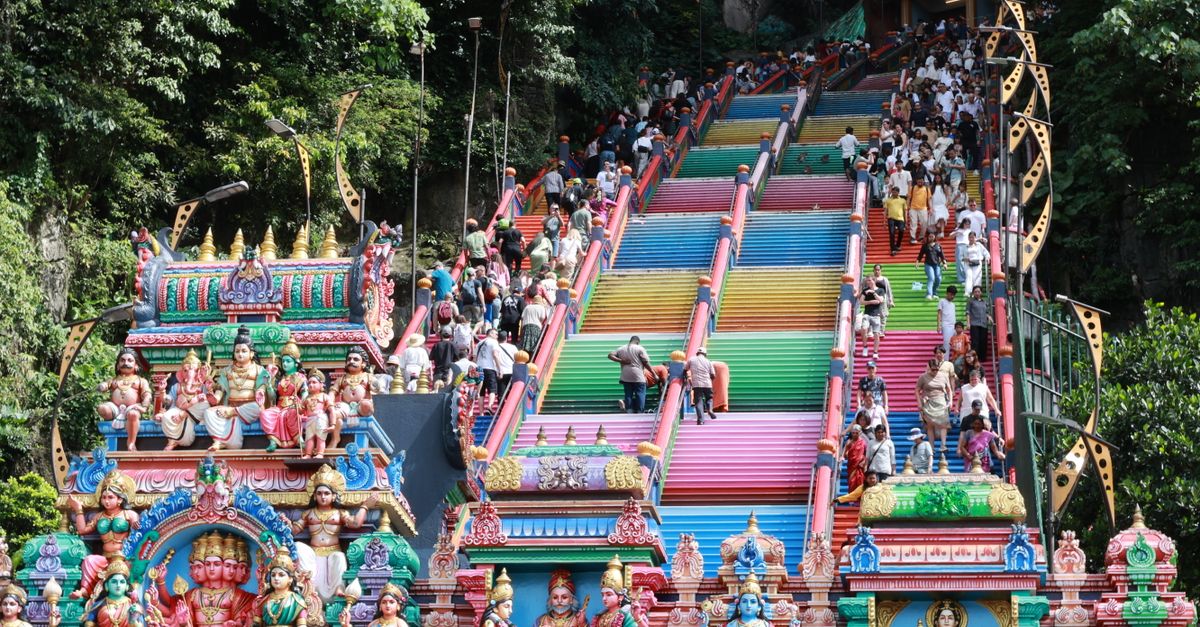
The 272 steps lead to Temple Cave, also known as Temple Cave or Cathedral Cave. Their colourful makeover in 2018 increased the site’s photographic popularity, but the climb remains above all the route to the upper shrine.
Inside, the contrast with the esplanade is striking: a high limestone vault towers over the religious installations, while some openings allow natural light to enter. The route still includes indoor stairways, so reaching the top of the outdoor flight does not mean that all the effort is over.
Take the example of Camille and Julien, a fictional couple planning their first morning on site. By first viewing the statue from below and then climbing without rushing, they get a better sense of the different areas than they would by immediately looking for the viewpoint seen on social media.
Ramayana Cave, Dark Cave and additional areas
The Ramayana Cave, located in the lower part of the complex, offers a different experience, based on scenes depicting the epic of the Ramayana. The statue of Hanuman helps visitors identify this area; the narrative displays may appeal to those who want to understand the characters of Hindu mythology.
Other areas, particularly those associated with Cave Villa, may be operated separately and require a ticket. Check exactly what admission includes: an artistic presentation, an exhibition and a natural cave do not necessarily offer the same experience.
The Dark Cave is known for its ecological importance and its former guided tours. Guides that automatically advertise daily departures may be relying on outdated information: do not build your itinerary around this activity without directly confirming that it is open and checking its access conditions.
The illustrated AhMonTour visit account gives you an idea of the atmosphere, but does not replace official information about accessible areas. The upper shrine is the heart of the outing; the other caves remain optional additions to choose on site.
Batu Caves prices and opening hours: what is free and what to check
Free entry to the main Batu Caves shrine
For the search “Batu Caves prices”, the essential answer comes down to one distinction: ordinary access to the esplanade, the main staircase and Temple Cave is free. You therefore do not need to buy a tour to discover the site’s most iconic features.
A commercial offering may charge for transport, a guide or a combination with other attractions. Its price does not therefore correspond to a compulsory entrance fee for the shrine; check exactly what is included before booking.
Likewise, making an offering is a voluntary religious practice. It should not be confused with paying for a tourist ticket, and you can respectfully visit the accessible areas without taking part in a ritual.
| Area or service | Indicative pricing | Useful check |
|---|---|---|
| Esplanade, staircase and Temple Cave | Ordinary access free | Temple administration guidelines and occasional restrictions |
| Ramayana Cave | Usually paid admission, separate from the shrine | Official price displayed at its ticket booth |
| Cave Villa and other private areas | Separate ticket depending on the area operated | Ticket contents and price displayed by the operator |
| Dark Cave | Do not assume that old prices are current | Opening and conditions confirmed by the operator |
| Train, car or guided tour | Paid transport and services | Operator’s price at the time of travel |
The information in this table provides indicative guidelines, not a guaranteed price list for 2026. For the secondary caves, the official ticket office of each operator remains the reference point; an old photo of a sign or a travel article may show an outdated price.
Camille and Julien can therefore plan an outing including only the train, water and possibly a meal. If they later decide to add a visit to a secondary cave, they check the price requested and what the experience includes before buying their tickets.
Batu Caves opening hours: planning your visit without relying on an approximate time
The shrine generally welcomes visitors from morning until evening, but opening hours may differ between the main complex, places of worship and paid areas. Confirm access times with the temple administration and its official notices, particularly during festivals and construction work.
Arriving early in the morning is a good way to limit exposure to the heat and enjoy what is often a quieter period. This does not mean that a specific time guarantees peace and quiet: a weekend, ceremony or arrival of groups can quickly change the atmosphere.
Allow some leeway rather than planning a tight schedule between two bookings. The climb, breaks, time spent looking around the shrines and a possible shower of rain can take varying amounts of time; the secondary caves make the route even longer.
The Hello Kuala Lumpur practical guide to the site offers another perspective on planning an outing. For any information that may change, however, compare guides with the information provided by the relevant operator.
Finally, keep some cash for small expenses, without assuming that every ticket office accepts bank cards. The budget mainly depends on transport and the options you choose, not on access to the main temple.
How to get to Batu Caves from Kuala Lumpur by KTM train
The KL Sentral–Batu Caves journey with KTM Komuter
To reach Batu Caves from Kuala Lumpur without negotiating a road journey, KTM Komuter is a practical option. From KL Sentral, look for a service heading to Batu Caves and check the departure board: the service is operated by KTM, not by the LRT or MRT networks.
The station bearing the site’s name is the terminus of this service. The system seems simple, but the interval between trains can have a greater impact on your total time than the journey itself; simply turning up at the station at random is therefore not always the most efficient strategy.
Check the official KTMB timetables and information before you leave. They allow you to check the applicable service, any disruptions and ticketing arrangements, rather than relying on a fare or journey time published several years ago.
References to “thirty minutes from Kuala Lumpur” should be understood as estimates for the rail journey under certain conditions, not as a guaranteed time from your hotel. Add the time needed to reach KL Sentral, buy your ticket, wait and walk the final stretch.
- Find your departure at KL Sentral in the KTM Komuter area and confirm the destination shown.
- Buy a valid ticket using the available sales facility and keep it until you exit.
- Get off at Batu Caves, then follow the pedestrian route towards the religious complex.
- Check your return journey before going up so that you can choose your departure time without rushing.
From the arrival station, the approach is on foot through the shopping area and the lower entrances. You should not normally need an additional vehicle to reach the esplanade; commercial approaches are not a compulsory part of the route.
In our example, Camille checks the departures while Julien prepares the route from their accommodation. They then choose their visiting time based on a real train, instead of arriving at KL Sentral expecting an imaginary connection every few minutes.
Grab, taxis and returning to central Kuala Lumpur
A car with a driver or a Grab may be more convenient if you are leaving from an area far from the station, travelling in a small group or accompanying someone who tires easily. The price depends on the departure point, demand and traffic; check the quoted amount before confirming.
The time saved on connections can disappear in traffic jams. During busy periods and religious gatherings, a road journey is therefore not automatically faster or more comfortable than travelling by rail.
For your return, choose an authorised pick-up point that is easy to identify, away from the path used by worshippers. Road closures may mean walking further: do not assume that your driver will be able to stop exactly where they dropped you off.
With children, keep some water for the return journey rather than drinking it all during the climb. If you would like to continue the day in the city centre, also avoid booking anything too soon after your expected departure from the shrine: the weather and transport can both delay your plans.
The best route is the one whose return journey you have checked, not just the outward journey.
Tip: set up a Malaysia eSIM before departure so your data works on arrival.
What to wear, monkeys and steps: practical tips for visiting Batu Caves
What to wear to enter the Batu Caves
Plan an outfit that covers your shoulders and knees, with opaque and comfortable clothing. This recommendation applies to all visitors and avoids relying on a dress check whose enforcement may vary depending on the area or the person responsible for welcoming visitors.
Lightweight trousers, a long skirt or a sufficiently covering dress works well in the tropical climate. By contrast, very short shorts, a very low-cut top or beachwear is not suitable for this place of worship, even if you only want to photograph the steps.
Taking a scarf or sarong can be useful, but do not assume that one will always be available to hire at the entrance. Our guide to dress codes in Malaysia also explains how to adapt your clothing to the country’s different religious spaces.
Keep your shoes on when walking outdoors and climbing the stairs, then remove them wherever a shrine requires this at the entrance. Following the signs and asking staff is more reliable than copying another tourist’s behaviour.
Climbing the Batu Caves steps with children or reduced mobility
The staircase requires real effort, made more demanding by the heat and humidity. Wear shoes that fit securely, keep moving at a steady pace and take breaks without blocking the way; the steps can become slippery when wet.
The main cave is not accessible at ground level, and its staircase is unsuitable for wheelchairs. The forecourt nevertheless allows you to see the statue and the site’s façade, subject to local access conditions, without attempting the climb.
With a pushchair, plan a different arrangement for the upper section: carrying it through a crowded area can become tiring and dangerous. A suitable baby carrier does not eliminate the effort or the risk of overheating either; your comfort and the child’s should guide your decision.
If someone close to you has heart, breathing or joint problems, do not present this climb as a mere formality. Seek medical advice if necessary and accept limiting the visit to the lower part of the complex rather than carrying on despite feeling unwell.
Batu Caves macaques: keep your distance
The monkeys are used to human presence, but they remain wild animals. Visible food, open bags and certain objects held in your hands may attract them; put your provisions away before starting up the stairs.
- Do not feed the macaques or try to touch them.
- Keep children close to you and do not give them visible food.
- Avoid close-up selfies and leave the animals a way out.
- If an object is snatched, do not confront the animal; ask staff for help.
In the event of a bite or scratch, immediately wash the wound thoroughly with soap and water, then see a healthcare professional promptly. Even a minor-looking injury deserves assessment; do not simply put on a plaster and carry on with your day.
Finally, ask people’s permission before taking a close-up portrait and respect photography bans in the relevant areas. A successful visit depends on keeping a respectful distance, both from worshippers and from the wildlife.
Thaipusam at Batu Caves and practical questions for planning your visit
Visiting Batu Caves during Thaipusam
Thaipusam is one of the shrine’s major religious events. Its date follows the Tamil calendar and usually falls in January or February; check the date for your year of travel with the organisers and in official Malaysian announcements.
The celebration honours Murugan and brings together devotees engaged in different forms of worship. Some carry milk containers as offerings, while others carry structures known as kavadi; the practices you see form part of personal religious preparation and commitments.
Rituals involving body piercings should not be reduced to a spectacular attraction. For an outside visitor, the right approach is to observe without causing disruption, touching participants or taking advantage of their vulnerability or concentration to obtain a close-up photograph.
Our overview of {1festivals and celebrations in Malaysia helps place this event in the national calendar. It also helps expats plan ahead for travel and crowds around the main gathering places.
Adapting your route to religious crowds
During this period, movement through the complex may be channelled and road access altered. Special transport arrangements are sometimes announced: check KTMB and the organisers rather than assuming that normal timetables will be sufficient.
If Camille and Julien are coming to explore the caves peacefully, they would be better off choosing another day. If they want to understand the festival, however, they must accept a slower pace, give up certain viewpoints and give priority to the participants.
With young children or someone who is sensitive to crowds, avoid very busy areas and identify a way to step away. Thaipusam should be approached as a major religious gathering, not as a normal tourist visit.
Frequently asked questions about visiting Batu Caves
How much does it cost to enter Batu Caves?
Regular access to the forecourt, the 272 steps and the Temple Cave is free. Some additional caves, particularly Ramayana Cave, generally require a separate ticket. Their prices should be checked on the official notices at each ticket counter. The train, any parking, a guide or an excursion are separate expenses, not a compulsory entrance fee for the main shrine.
What should you wear in Batu Caves?
Choose opaque clothing covering your shoulders and knees, ideally lightweight enough for the heat. Loose trousers or a long skirt with a covering top are suitable. Wear stable shoes for the stairs and remove them only where religious customs require it. Bring your own extra layer rather than relying on a rental at the entrance.
Is access to Batu Caves free?
Yes, you can see the site’s main features without buying a tourist ticket: the outdoor statue of Murugan, the staircase and the Temple Cave are part of the normally free route. This does not automatically apply to areas operated separately. Also respect any temporary restrictions linked to ceremonies, works or visitor management.
How do you visit Batu Caves?
Check the KTM Komuter times from KL Sentral, travel to Batu Caves station, then continue on foot to the complex. Aim to arrive early, take in the statue and climb at your own pace with water and clothing that covers your shoulders and knees. Only add a secondary cave after confirming that it is open and checking the price. Check your return train departure before starting the climb.
Book your Batu Caves tickets & activities
Skip-the-line tickets, guided tours and combined excursions (Batu Caves + Kuala Lumpur) on Klook, Asia’s No. 1 activities platform: often free cancellation, verified reviews and payment in euros.
Partner link — booking via this link supports us, at no extra cost to you.